
In modern industrial environments, unexpected equipment failures can cause massive disruption—halting production, creating safety risks, and costing organizations a median of $125,000 for every hour of unplanned downtime.
To minimize these risks, many operations have switched to condition-based maintenance using wireless IoT sensors (opens new window). This approach uses simple threshold rules, e.g., if temperature climbs above a set limit or pressure drops below a certain value, trigger an alert.
But what happens when something happens slowly, creating subtle patterns across multiple metrics that wouldn't individually trip an alarm?
This is where anomaly detection comes in.
What is Anomaly Detection?
Anomaly detection (AD) is an analytical technique used to identify unusual patterns in data sets, such as sensor readings from industrial equipment. AD systems provide critical insights across various domains, from fraud detection in financial transactions to network traffic analysis in cybersecurity. Their application in industrial environments offers unique advantages for equipment monitoring and predictive maintenance (opens new window).
Unlike traditional thresholding methods that examine metrics in isolation, anomaly detection models can analyze multiple data streams simultaneously, identifying anomalies that might otherwise slip through the cracks. By establishing baselines through data collection and historical data analysis, these systems excel at outlier detection across diverse operational scenarios.
As a key component of predictive maintenance strategies, anomaly detection helps organizations spot equipment issues before they escalate into failures. By catching these early warning signs, companies can schedule maintenance proactively, reducing unplanned downtime and improving overall operational efficiency.
Benefits of Anomaly Detection in Industrial Settings
No Data Scientist Required
One of anomaly detection's most compelling advantages is its accessibility. While machine learning often requires extensive feature engineering and ongoing tuning by specialists, many statistics-based anomaly detection methods work out-of-the-box with minimal setup. This democratizes advanced analytics, putting powerful tools in the hands of engineers and operators who understand their equipment best.
Superior to Simple Thresholding
Traditional threshold-based alerts examine metrics individually, missing complex problems that manifest across multiple parameters. An anomaly detection algorithm can simultaneously analyze temperature, vibration, pressure, flow rates, and other time series data, identifying subtle deviations from normal behavior that would never trigger individual alarms.
High Sensitivity
By establishing a baseline of normal operations through historical data analysis, these systems can flag even minor deviations that suggest emerging issues. This sensitivity enables earlier intervention, often catching problems days or weeks before they would cause equipment failure.
Industrial Use Cases
The versatility of anomaly detection makes it applicable across virtually any industry with sensor-equipped assets:
Manufacturing: Detect process deviations, equipment wear, or quality defects on production lines. Automotive manufacturing facilities use anomaly detection systems for identifying anomalies in robotic arm movement or welding consistency.
Oil & Gas: Early detection of pressure surges, gas leaks, or flow anomalies helps prevent catastrophic failures and environmental incidents.
Water Utilities: Monitor pressure and turbidity anomalies to detect leaks and contamination before they affect service quality or public health.
Renewable Energy: Identify inverter failures, solar panel degradation, or wind turbine imbalance to maximize energy production and asset lifespan.
Mining: Spot abnormal equipment vibrations, conveyor flow issues, or environmental hazards like dust or gas surges in challenging operational environments.
Food & Beverage: Detect temperature / humidity anomalies in cold chain logistics to ensure product quality and safety.
How Does Anomaly Detection Work?
Several anomaly detection methods exist, ranging from statistical approaches to machine learning techniques. The choice of method depends heavily on the type and quality of data you have, the complexity of the system, and the operational requirements.
It's also important to note that supervised learning isn't an option unless you have labeled examples of both normal and anomalous behavior-something most industrial environments don't possess. In practice, this means anomaly detection typically relies on either statistical methods or unsupervised machine learning.
Unsupervised approaches such as One-Class SVM or Isolation Forest can be powerful, but they come with their own challenges. They require careful hyperparameter tuning, and they often assume a certain proportion of outliers in the dataset, which may not reflect reality.
Statistics-Based Anomaly Detection
One particularly effective technique for industrial applications that conform to a roughly elliptical or normally distributed pattern is the Mahalanobis distance (MD) method. This statistical approach measures how far current readings deviate from "normal behavior" across multiple metrics simultaneously.
The system first analyzes historical data to establish what normal operations look like—understanding not just typical values, but also how the multi-metric mean, the shape of the typical data cloud, and how metrics correlate with one another.
MD works best when the underlying data is approximately elliptical; if the data actually forms separate, distinct clusters, the algorithm will still compute a distance, but the result is rarely meaningful for anomaly detection.
Once you've established this baseline, the algorithm calculates a single anomaly score representing how unusual the current state is compared to normal operations. This transforms complex, multivariate data into a simple, actionable metric that efficiently captures how “normal” any given timestamp is.
Machine Learning Approaches
More advanced methods include supervised learning techniques like XGBoost, which requires labeled training data, and unsupervised approaches like isolation forest, which can detect outliers without prior examples of failures. These machine learning-based anomaly detection systems may offer advantages for complex patterns but typically require more expertise to implement and offer less overall information, typically classifying the data into a simple 0 or 1 rather than a continuous output. .
Implementing Anomaly Detection: A Practical Example
Consider a production manager at Celtic Engineering, a fictional manufacturing company, who is monitoring a gas compressor on the assembly line. The engineer lacks time and expertise to develop custom models but wants to go beyond simple if-then thresholding for the five metrics he tracks.
An IoT device monitors the compressor through data collection of pressure, temperature, vibration, and other critical parameters. On the Davra platform, the engineer sets up an anomaly detector, specifying which metrics to analyze and adding the compressor to the list of monitored devices. The system automatically calculates a baseline from the historical data from that point on — no data scientist required.
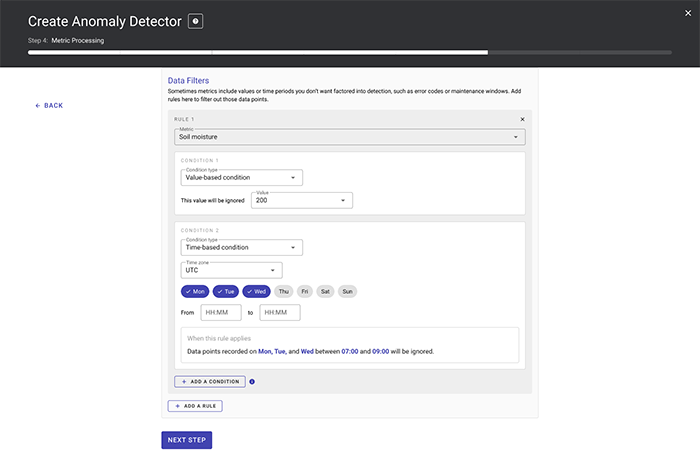 Anomaly detection setup screen in the Davra Platform
Once configured, the engineer can track a single metric that shows how far current operations deviate from normal at any point in time. Instead of monitoring five separate thresholds, they can set up straightforward rules based on the new anomaly detection metric and use visualizations based on the anomaly score. When the score exceeds their specified tolerance—say, a distance threshold of 20—alerts trigger automatically.
In practice, this approach enables early detection of emerging issues. A single anomaly spike may not be a concern, but multiple spikes appearing three days before a failure provides time for scheduled maintenance, avoiding the production disruption of an unexpected breakdown.
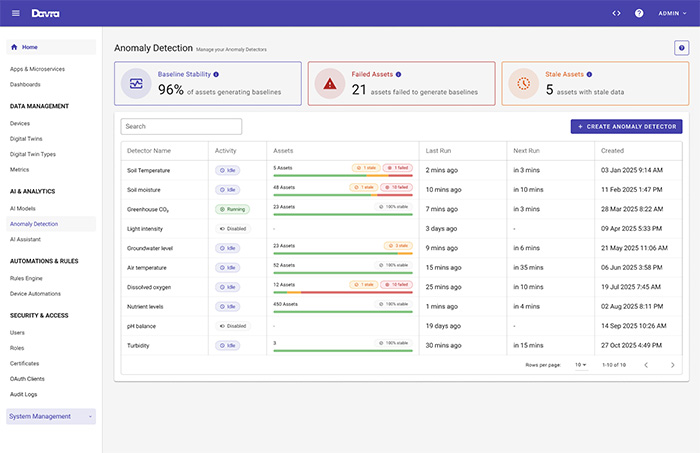 Anomaly Detection overview in the Davra Platform
Conclusion
Anomaly detection represents a practical middle ground between basic threshold alerts and complex implementations.
By making outlier detection accessible to industrial operators and providing high sensitivity across time series data, it's becoming an essential tool for modern predictive maintenance strategies.
As industries continue embracing IoT sensors, anomaly detection will play an increasingly vital role in keeping critical equipment running reliably.
Curious what anomaly detection could do for your equipment and teams? Discover Davra’s AI solutions (opens new window) and speak to one of our AI experts today.

Tips and IIoT insights to help you transform your business




Copyright © Davra Networks 2026. All rights reserved.
Tips and IIoT insights to help you transform your business

Cookie & Privacy Policy
Copyright © Davra Networks 2026. All rights reserved.